Considering its high efficiency and effectiveness, it’s understandable that people might worry about CBD oil’s potential negative consequences, given its powerful capabilities. CBD and other cannabinoids are the subject of ongoing studies to determine their precise role in pain management, stress reduction, sleep regulation, and other health benefits.
Concerns about the potential adverse effects of cannabidiol (CBD) continue to be raised as more information about CBD, and medical cannabis becomes available. We do know that it can have serious adverse effects on those with heart problems and other risk factors when used with certain drugs.
Can CBD oil thin blood on its own? Where to buy CBD oil? What are the effects of CBD oil when combined with blood thinners like warfarin? Does CBD need to be stopped before surgery? In this detailed guide to CBD oil and blood thinners, you’ll find the answers to these questions and more.
What Are Blood Thinners?
The three main types of blood vessels that carry blood throughout the human body are the arteries, veins, and capillaries. When compared to the typical male human height of 176.5 cm (or 0.001 miles), the average speed of blood is between 3 and 4 miles per hour, which is fairly rapid.
Platelets are cells that aggregate to form blood clots when the body needs to stop blood flow, such as after a cut or injury. You may be familiar with clotting disorders like Deep Vein Thrombosis and plaque accumulation on artery walls that can cause pulmonary embolisms and other life-threatening complications.
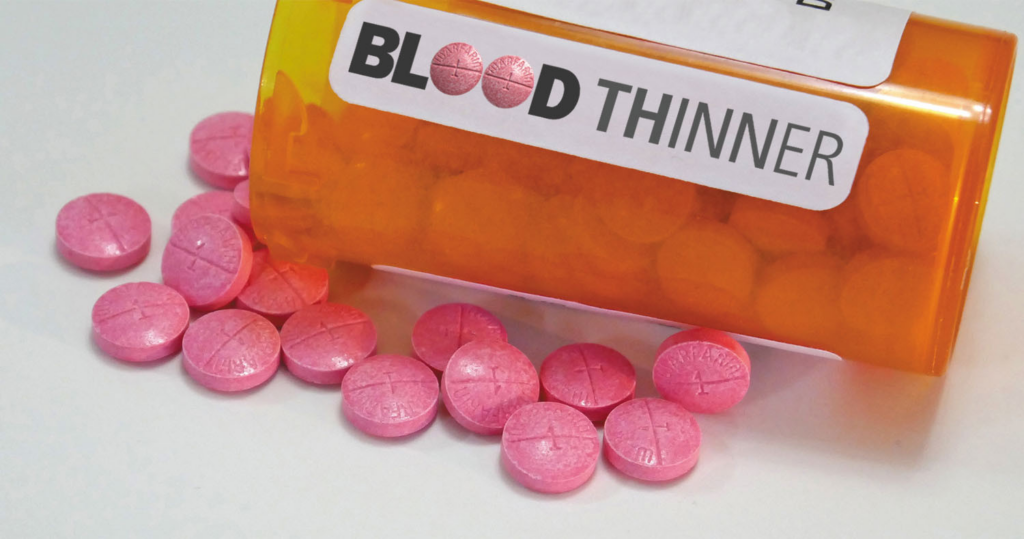
Problems like these are what blood thinners are designed to treat and avoid. Anticoagulants do not really thin or dilute the blood. They accomplish their usefulness by preventing the onset of blood clots and slowing the growth of existing ones. To reduce the risk of another cardiovascular incident, blood thinners are given to patients who have previously experienced one of these conditions.
The ability to adapt the blood’s viscosity and the formation of clots to changing circumstances is essential. One study found that cannabidiol (CBD) “inhibits CYP2C19, boosting levels of the active metabolite of clobazam twofold.”
Warfarin is a prominent anticoagulant sold under the brand name Coumadin, and the researchers note that marijuana use may have “serious interactions with medications like warfarin.”
What this means is that CBD and other hemp extracts may interfere with the inhibitors, rendering blood thinners like warfarin ineffective. However, what about those who don’t take anticoagulants? They want to know if using CBD oil presents any dangers.
CBD Oil and Blood Thinners
Blood-Thinning Drugs and CBD Oil provide a risk of excessive blood-thinning if taken together. Thus, it appears that CBD oil possesses inherent anticoagulant properties.
Researchers showed that when administered into an animal specimen, cannabis sativa and the cannabinoids tetrahydrocannabinol (THC) and cannabinol (CBN) “exhibit anticoagulant action.” Unlike the other two extracts, CBD was not picked out. Do CBD products, then, offer the same benefits as those other two cannabis plant extracts?
The consensus is that cannabidiol oil does have an effect on blood viscosity. CBD, according to Harvard Health Publishing, “increases the level of blood-thinning and other medicines in your blood by competing for the liver enzymes that break these drugs down.”
They go on to say that grapefruit is also known to have this impact. The UK’s National Health Service (NHS) warns those using warfarin to stay away from grapefruit juice, but it also lists alternatives to warfarin that are safer when consumed with grapefruit juice because of competition in the liver’s enzyme system.
Following this line of reasoning, it would seem that anyone concerned about negative drug interaction, bleeding complications, suffering from heart disease, having a history of stroke, or otherwise being vulnerable to potential complications from CBD products should avoid taking them without first discussing them with a medical professional.
Is CBD Oil Safe for Surgical Use?
Some medical professionals recommend that patients stop consuming CBD oil at least 48 hours prior to an upcoming treatment, while others don’t see it as a major concern. Without a doubt, doctors have the know-how to recognize the red flags in patients and make an educated call about treatment.
You may find it reassuring to learn that, in most instances, a patient’s medical history of CBD use will not prevent them from receiving the care they require.
In light of this, it is understandable that medical experts are being cautious, even if research into the effects of CBDs on blood thinning and interactions with blood thinners is by no means comprehensive. If you want to make sure you’re using CBD safely, it’s essential to ask a doctor for help.
Does Using CBD Oil Reduce Blood Pressure?
Research on this topic is generally consistent. According to the results of a promising study conducted in 2017, “acute administration of CBD reduces resting blood pressure and the blood pressure increase to stress in humans, associated with an increased heart rate,” which translates to a decrease in resting blood pressure after a single dose of cannabidiol. The study involved 9 participants.
Is it possible that a regular dose of CBD oil could help those who need to gradually lower their blood pressure? This is when the studies start to show less promise. CBD “has not influenced blood pressure in hypertensive animals,” according to a study from 2020. According to the same study, low blood pressure (hypotensive action) more commonly happens in stressful conditions.
Evidence from other studies suggests that using CBD during times of stress can have a beneficial effect on blood pressure. However, the evidence either does not support or is inconclusive about the possibility of CBD as a therapy option for the long-term lowering of blood pressure. You may assume that if your blood is thinner, your blood pressure will be too, but this is not the case.
Blood pressure is generated by the heart’s contractions, and coagulation serves to prevent both internal and exterior bleeding. The addition of platelets to the circulatory system has no effect on blood pressure. In thrombosis, when platelets fully shut off the flow, blood pressure remains constant.
But for some, such a sudden dip in blood pressure could spell trouble. It’s not a good idea to use CBD oil or other products derived from the hemp plant if you have difficulties with your blood pressure being too low in general.
Finally
CBD oil, cannabis oil, and cannabidiol CBD have been used consistently in the treatment of conditions such as chronic pain, anxiety disorders, cancer treatment, multiple sclerosis, post-traumatic stress disorder, and other health benefits. To know more about buying CBD oil in Australia and other hemp seed oil benefits, you should book a consultation session with a professional from Chronic Therapy today.
If you are also looking for information about scientific evidence that supports both CBD oil and other medicinal cannabis product usage, you are in the right place. You will also be informed about every adverse effect, preclinical evidence, and symptom related to CBD and hemp seeds, including their potential health benefits, hemp-derived CBD products, and dietary supplements, how cannabidiol reduces cigarette consumption and as a potential anticancer drug; where to buy CBD oil legally and state medical marijuana laws.